
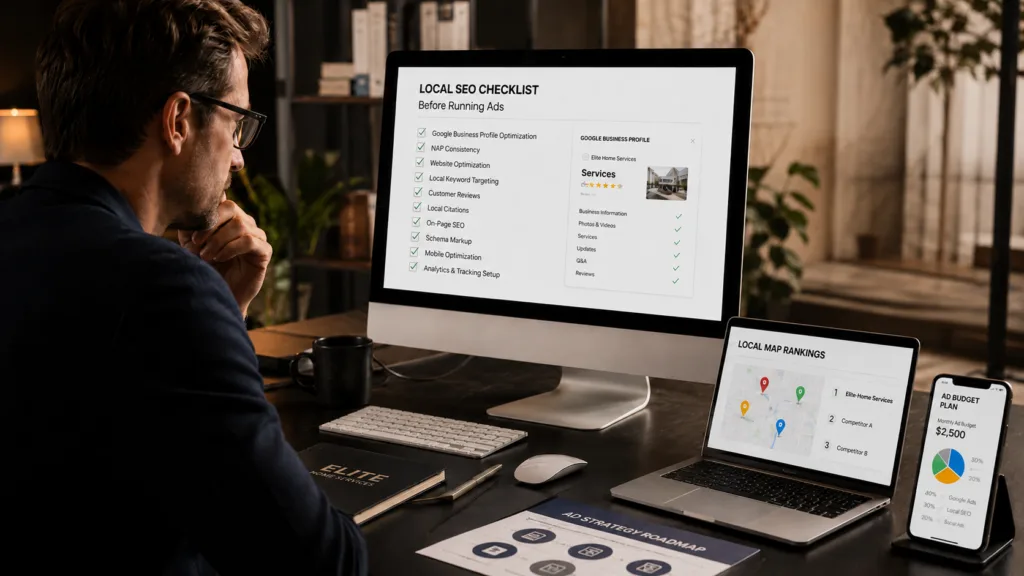
A dental local SEO checklist helps your practice fix the visibility issues that paid ads often cover up.
Paid ads can generate leads quickly, but if your dental practice has weak local SEO, you may be paying for visibility you could be earning organically.
Before increasing your Google Ads budget, your practice should make sure the basics of local search are working properly.
Local SEO helps patients find you when they search for terms like:
*dentist near me
*emergency dentist near me
*dental implants [city]
*Invisalign dentist [city]
*cosmetic dentist [city]
*family dentist [city]
These are high-intent searches. The person searching is not casually browsing. They are often ready to compare options, call, or book.
If your practice is not showing up in Google Maps, local organic results, and service-specific searches, your competitors are capturing demand that should be yours.
Why a Dental Local SEO Checklist Matters Before More Ad Spend
Advertising works best when it supports an already credible digital presence.
Imagine a potential patient clicks your ad, then sees weak reviews, an incomplete Google Business Profile, thin service pages, or a slow website. That click becomes expensive very quickly.
Strong local SEO improves your entire marketing ecosystem. It makes your practice easier to find, easier to trust, and easier to choose.
Before spending more on ads, use this checklist to identify whether your foundation is strong.
Dental Local SEO Checklist Step 1: Optimize Your Google Business Profile
Your Google Business Profile is one of the most important local visibility assets your practice has.
Google’s Business Profile help page explains that businesses can update details like address, hours, contact information, and photos to help customers find and learn more about them.
Make sure your profile includes:
*Correct practice name
*Accurate address
*Local phone number
*Website link
*Appointment link
*Primary and secondary categories
*Services list
*Business hours
*Holiday hours
*Practice photos
*Team photos
*Exterior and interior photos
*Regular updates or posts
For dentists, categories and services matter. Your profile should clearly communicate what you offer, whether that is general dentistry, cosmetic dentistry, implants, emergency care, pediatric dentistry, orthodontics, or other specialties.
Dental Local SEO Checklist Step 2: Build a Consistent Review Strategy
Reviews are not just reputation assets. They influence trust, click behavior, and local decision-making.
A dental practice with recent, detailed, positive reviews has a major advantage over one with outdated or generic reviews.
Your review strategy should include:
*Asking satisfied patients consistently
*Making the review process easy
*Responding professionally to positive and negative reviews
*Encouraging detailed feedback without scripting reviews
*Monitoring review trends and patient concerns
Patients often look for specific signals in reviews, such as comfort, friendliness, pain-free experiences, clear explanations, professionalism, and results.
Your reviews should help future patients feel safer before they ever contact you.
Create dedicated service pages
A single “Services” page is not enough if you want to rank for valuable dental searches.
Each priority service should have its own optimized page.
Examples include:
*Dental implants in [City]
*Invisalign in [City]
*Cosmetic dentistry in [City]
*Emergency dentist in [City]
*Teeth whitening in [City]
*Root canal treatment in [City]
*Family dentistry in [City]
Each page should include:
*A clear headline
*Patient-focused explanation
*Benefits of the service
*Who the service is for
*What to expect
*Trust signals
*FAQs
*Strong call-to-action
*Local relevance
Service pages give Google more context and give patients more confidence.
Make sure your website is technically healthy
A beautiful website can still underperform if it has technical SEO issues.
Check for:
*Slow page speed
*Poor mobile experience
*Broken links
*Missing title tags
*Duplicate meta descriptions
*Missing image alt text
*Confusing site structure
*Pages not indexed by Google
*Lack of schema markup
Technical SEO may not be visible to patients, but it affects how easily search engines understand and rank your site.
Use local keywords naturally
Local SEO is not about stuffing city names everywhere. It is about making your relevance clear.
Your site should naturally include:
*City name
*Neighborhoods served
*Nearby communities
*Service-specific local phrases
*Directions or local landmarks where helpful
*Location-specific FAQs
For example, instead of writing “best dentist city dentist near me dentist,” write content that genuinely helps a local patient understand why your practice is a strong choice in their area.
Google is increasingly focused on helpful, people-first content. Your content should serve patients first and search engines second.
Google’s SEO Starter Guide explains that SEO helps search engines understand content and helps users decide whether they should visit a site.
Dental Local SEO Checklist Step 4: Strengthen Internal Linking
Internal links help visitors and search engines move through your site.
For example, a blog post about dental implants should link to your dental implants service page. A cosmetic dentistry page may link to veneers, whitening, Invisalign, and smile makeover pages.
A strong internal linking structure helps:
*Improve SEO context
*Increase time on site
*Guide visitors toward conversion
*Show relationships between services
*Support priority pages
If your best pages are buried, they are less likely to perform.
Track calls, forms, and appointment requests
You cannot improve what you do not measure.
Your dental practice should track:
*Website calls
*Contact form submissions
*Appointment requests
*Google Business Profile calls
*Direction requests
*Organic traffic
*Service page performance
*Conversion rate by page
*Lead source quality
Ranking alone is not the goal. New patient growth is the goal.
Publish helpful content that answers real patient questions
Blogging is not about posting random dental tips. It should support patient education, SEO, and trust.
Strong content topics include:
*How much do dental implants cost?
*Is Invisalign worth it?
*What should I do during a dental emergency?
*How do I choose a cosmetic dentist?
*Why are my gums bleeding?
*What happens during a new patient exam?
The best content answers questions patients are already searching for and guides them toward the right next step.
Align your website with your Google Business Profile
Your website and Google Business Profile should reinforce each other.
Make sure your name, address, phone number, hours, services, and appointment links are consistent.
If your Google profile promotes emergency dentistry but your website barely mentions it, you are creating a trust and relevance gap.
Alignment improves both user experience and search clarity.
Final Thought on Your Dental Local SEO Checklist
If your local SEO foundation is weak, more ad spend can become a short-term patch for a deeper visibility problem.
But when your Google Business Profile, website, service pages, reviews, and tracking are strong, every marketing dollar works harder.
How INIZIO helps dental practices build stronger local visibility
INIZIO helps dental practices and service-based businesses build marketing systems designed for visibility, trust, and leads.
We connect local SEO, website conversion, content strategy, Google Business Profile optimization, and analytics so your practice can grow with more confidence.
Before spending more on ads, make sure your organic foundation is built to win.
Ready to strengthen your dental local SEO checklist? Contact INIZIO to improve your visibility, trust, and lead generation before spending more on ads.